
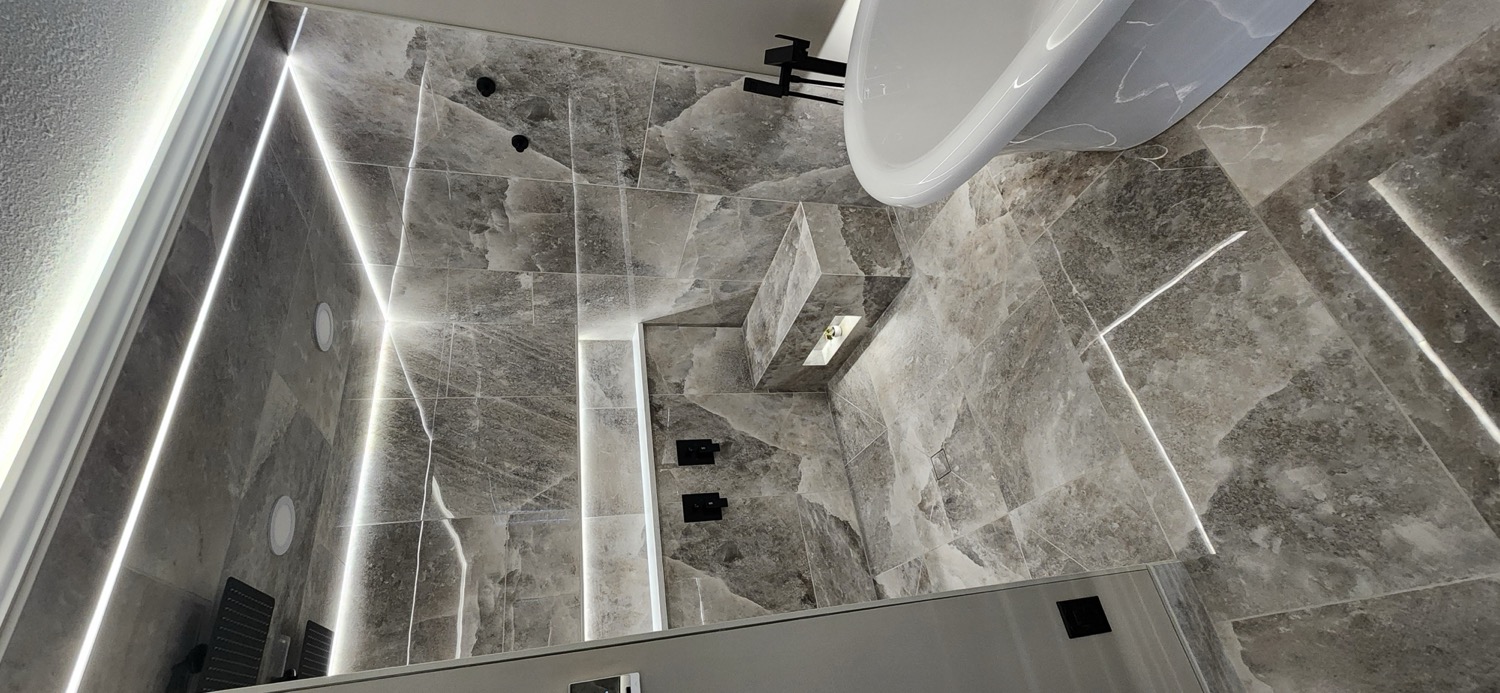
Pattern flow starts with flat, plumb walls
Why wall preparation, KERDI-BOARD alignment and deliberate tile selection matter when large-format patterns continue around corners.
A tile pattern that continues around a corner can look effortless. The work starts much earlier: with the shape of the walls, the position of the niche and the way individual tiles are selected. Good preparation gives the layout a reliable foundation. It does not replace the design decisions that make the finished room feel connected.
Flat and plumb are different checks
A flat wall has no unwanted humps or hollows across its surface. A plumb wall stands vertically. A wall can be flat but lean, or stand vertically while individual studs create an uneven face. Corners introduce a third consideration: whether the two wall planes meet at the angle the design requires.
Those distinctions matter when a long tile crosses several studs or a horizontal joint has to meet a niche, bench or adjoining wall. WNA’s approach is to resolve the substrate geometry before treating finish tile as the solution.
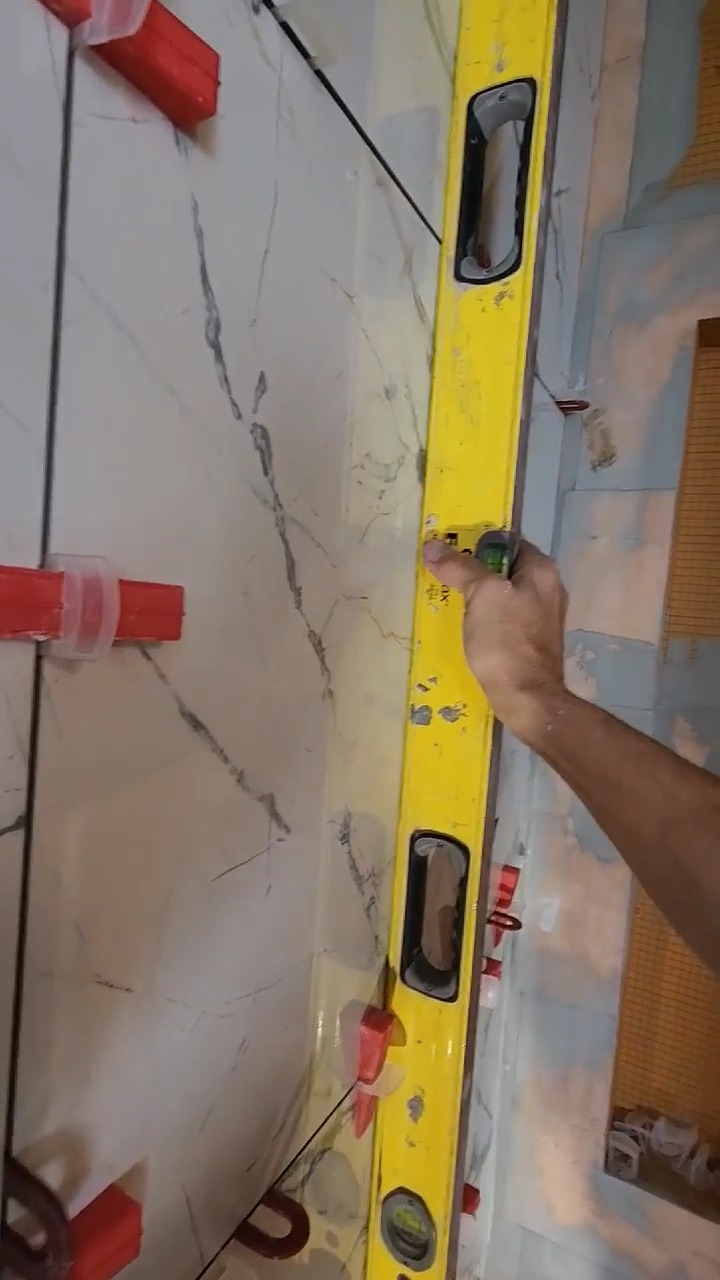
A still from WNA's on-site footage, with the level held against the tile during installation.
Select the image to view the full-size still.Two ways to correct the supporting plane
Wet shimming KERDI-BOARD
Wet shimming adjusts the support behind the board, rather than trying to disguise an uneven wall with the finish tile. Schluter demonstrates this method for KERDI-BOARD over studs in its official wet-shimming guide.
The board is brought into the required plane over the prepared mortar support. Mortar selection, allowable correction, curing and final fastening must follow the current manufacturer instructions. This is not permission to wet-shim every brand of wall board, and it is not the same as spot-bonding finish tiles.
Purpose-made high-density foam shims
Another approach is to correct the framing face with purpose-made shims before installing the board. Different thicknesses compensate for different offsets, rather than making the panel bend to follow the framing.
Built With Foam describes its foam shims as suited to foam wall-panel systems such as KERDI-BOARD. Product compatibility, support locations and fastening still matter. These are manufactured installation components, not substitutes made from miscellaneous packaging foam.
The method is chosen for the actual framing and assembly. Neither approach replaces the panel’s required fasteners, joint treatment or waterproofing. Schluter’s KERDI-BOARD installation information remains the reference for the board system. These are preparation options, not a record of which shimming method was used in every project shown on this website.
The pattern still needs a plan
Once the wall geometry is controlled, the tile itself needs attention. Faces are compared, orientations considered and cuts planned so a strong vein does not abruptly disappear at an important corner. A coordinated corner wrap is a layout decision, not an automatic consequence of buying a stone-look tile.
Not every tile range is supplied as a bookmatched set. The aim is a considered visual relationship between adjacent pieces, not a promise that every printed vein will match perfectly. The corner also still needs the movement accommodation specified for the assembly; visual continuity does not mean eliminating that joint.
See the preparation and the result
The Luminous Smoke build story places the wall-preparation photographs beside the finished niche and bench. Copper Elegance shows a different large-format pattern and the challenge of rebuilding around existing glass. In both kinds of layout, decisions behind the finish influence the lines people notice afterwards.
The useful question is not only, “Which tile do I like?” It is also, “What needs to be prepared so that tile can look intentional in this room?”